A Practical Generative AI Learning Roadmap for Engineering Students
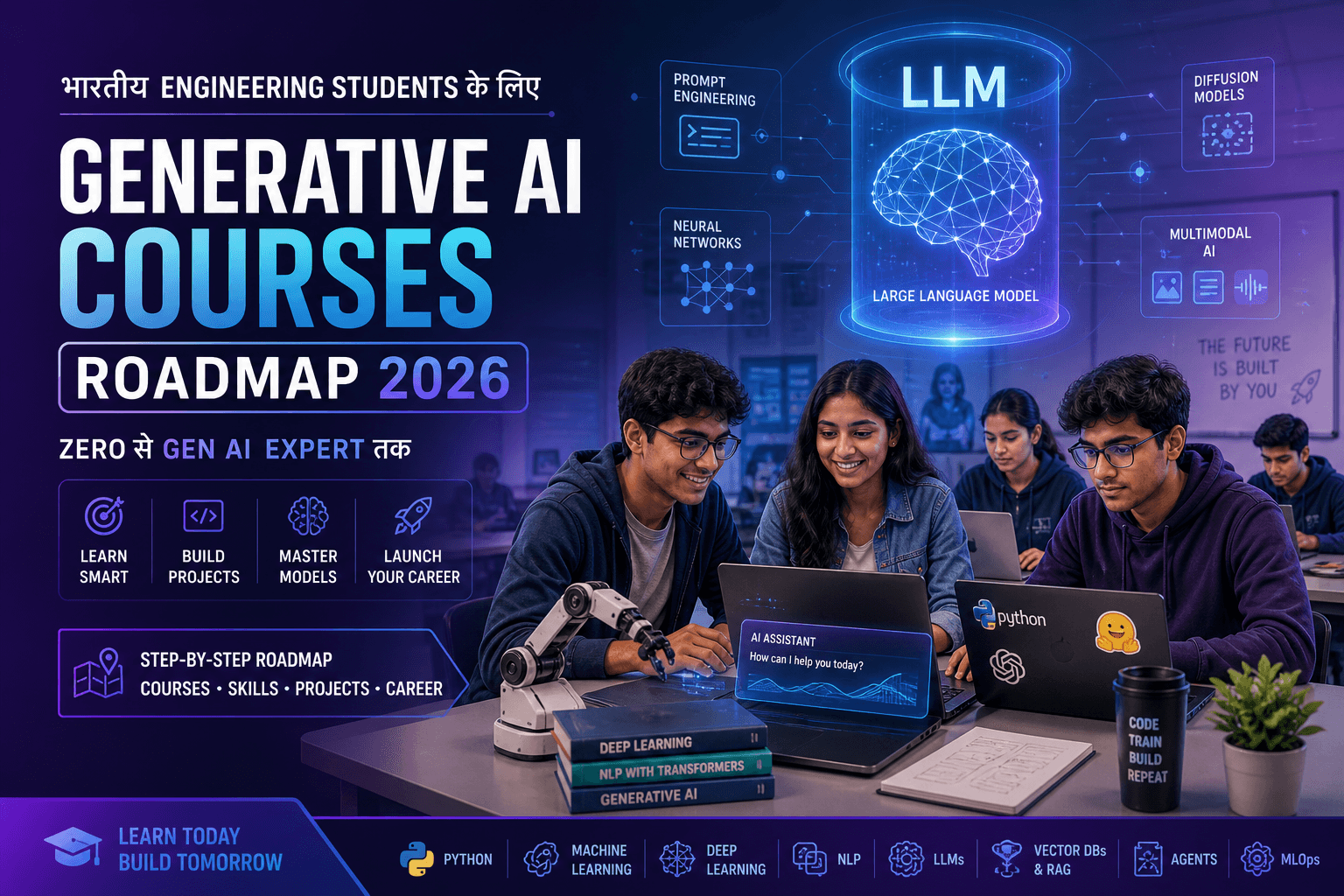
Learn the foundations, build a small retrieval app, test its limits, and turn the work into a portfolio project. Choose free learning resources by what they teach—not by certificate promises.
Learning Phase 1
Choose one role to learn toward
Generative AI work can mean application development, machine learning engineering, data engineering, evaluation, research, or product integration. These jobs overlap, but their day-to-day work is different.
Collect five current job descriptions for one role family. Mark repeated requirements and separate essentials from optional tools. Use that list to decide which course or project deserves your time.
Learning Phase 2
Build the programming and data foundations
Before adding an AI framework, get comfortable reading and changing a small program. Practice a language used in your target roles, Git, the command line, HTTP requests, JSON, and basic data handling.
For Python learners, the official tutorial is a reference—not a deadline. Use short exercises to practice functions, files, errors, and tests, then apply each concept to a small task.
Learning Phase 3
Learn model APIs and basic application design
Make one model request from a small application. Keep credentials out of source code, handle timeouts and invalid responses, and record the input and output format. Learn when to avoid sending private or sensitive data to a service.
A convincing demo should explain what happens when the model is wrong, the request fails, the user asks outside the supported task, or the available data is incomplete.
Learning Phase 4
Add retrieval only when your project needs it
A retrieval-augmented generation (RAG) workflow usually prepares documents, splits them into passages, indexes those passages, retrieves likely matches for a query, and supplies selected context to a model. A vector database is one possible index; it is not automatically the right choice for every collection.
Test the retrieved passages separately from the generated answer. Include questions with no answer in the documents, similar but irrelevant passages, and changes to the source files. Compare the result with a simpler keyword or database search before adding complexity.
Learning Phase 5
Evaluate the behavior and protect the data
A polished chat window is not evidence that an AI feature is dependable. Write down what a good answer looks like, test repeatable cases, inspect citations, and record incorrect or unsupported answers.
Review privacy, access boundaries, prompt injection, logging, and cost before sharing a demo. Security guidance changes; use current primary documentation and keep a short note of the version you followed.
Learning Phase 6
Turn the project into evidence for applications
A portfolio project is strongest when a reviewer can run it and understand your decisions. Include a concise problem statement, architecture sketch, setup steps, example inputs and outputs, test method, limitations, and your own contribution.
Describe skills accurately. A tutorial you followed can still be useful work, but explain what you changed and what you now understand rather than presenting it as a production system.
Learning Phase 7
A flexible six-week practice plan
Use this as a planning template, not a promise of job readiness. Adjust it around classes, work, prior programming, and the roles you are targeting.
- Week 1: review job descriptions and identify gaps.
- Week 2: practice programming, APIs, Git, and basic data handling.
- Week 3: build a small application using an existing model.
- Week 4: add retrieval if the use case needs it; compare a simpler baseline.
- Week 5: test quality, failure behavior, privacy, and reliability.
- Week 6: document the work, request feedback, and revise your applications.
Sources and further reading
संबंधित लिंक
अक्सर पूछे जाने वाले प्रश्न
पाठकों के सामान्य प्रश्नों के उत्तर
इस विषय से जुड़े त्वरित प्रश्न और सरल उत्तर।
Should I train a language model as my first AI project?
Usually not. Start by building an application around an existing model or a small open model. That lets you practice software, data, evaluation, and reliability without the cost and complexity of training.
Do I need Python before learning generative AI?
Python is useful for many AI application examples, but the best first language depends on your target roles. Learn enough programming, APIs, and debugging to understand the code you use.
Is RAG needed for every AI application?
No. Retrieval can help when an answer needs information from a document collection. It adds data preparation, access-control, evaluation, and maintenance work, so compare it with simpler approaches.
Will a course or certificate get me hired?
A course can structure learning, but it cannot guarantee a job. Be ready to show what you built, how you tested it, and what its limits are.
प्रश्न पूछें
इस विषय पर अपना सवाल भेजें
नीचे फॉर्म भरें — आपका संदेश सीधे हम तक पहुँचेगा। विस्तृत जवाब blog या video के रूप में।
लेखक
PixMorphy Editorial Team
PixMorphy Editorial Team
PixMorphy publishes practical guides on careers, software, automation, and AI. Articles are reviewed for accuracy, privacy, and clear sourcing.
संबंधित लेख
इस विषय से जुड़े और लेख
यदि यह लेख उपयोगी लगा, तो ये संबंधित लेख भी देखें।

How to Start an AI Career: A Roadmap for Beginners
Choose an AI role before choosing a course. This guide explains the skills to build, a small project to try, ways to evaluate it, and how to prepare for entry-level applications.

How to Compare AI Engineer Salaries in India and the US
A salary guide is a starting point, not a personal forecast. Use this checklist to compare job scope, source quality, location, and the full compensation package without treating unlike data as equivalent.

Your First Technology Job: A Practical Plan for Graduates
Choose a role, build one clear project, and apply with evidence. A realistic guide for new graduates that does not promise a shortcut or a guaranteed offer.