How to Start an AI Career: A Roadmap for Beginners
Choose an AI role before choosing a course. This guide explains the skills to build, a small project to try, ways to evaluate it, and how to prepare for entry-level applications.
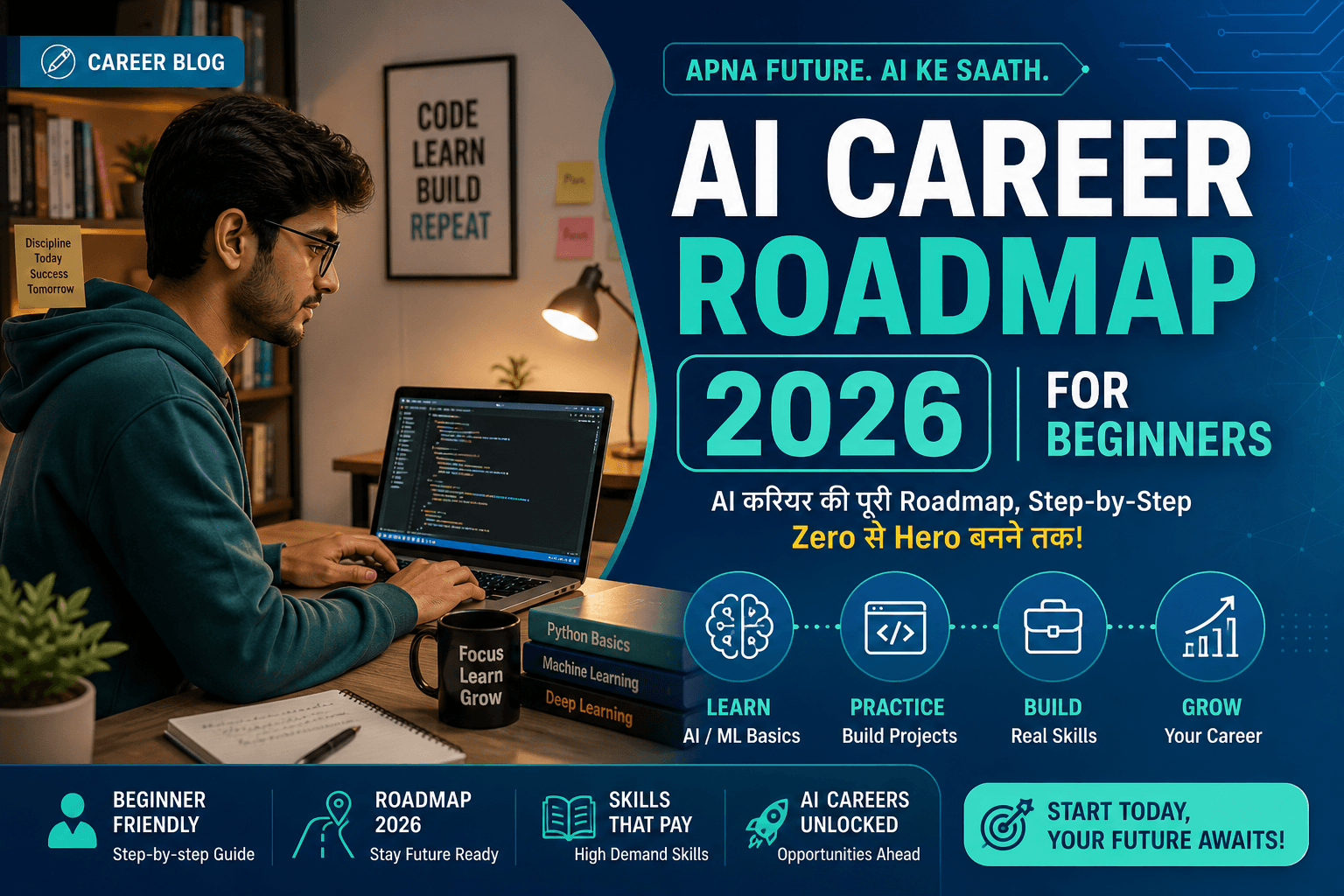
Pick a role family, not a trending tool
AI work includes AI application development, machine-learning engineering, data engineering, analytics, evaluation, and research. The names overlap, but the day-to-day responsibilities can be very different.
Review several current job descriptions for the same role family. Write down the tasks, repeated skills, required education or experience, and the tools marked as optional. This gives you a more useful learning plan than a list of popular frameworks.
Build foundations that transfer between tools
- Programming fundamentals in a language used by your target jobs.
- Git, command-line basics, HTTP APIs, JSON, and debugging.
- Data cleaning, validation, and basic SQL.
- Basic statistics and model concepts appropriate to the role.
- Privacy, security, and the limits of generated output.
Make a small end-to-end application
Start with one user problem and a narrow feature that you can finish. For example, a study helper could answer questions from a set of public notes, but only if you can show which notes support each answer.
Build a simple version first. A model call, a clear interface, helpful error messages, and setup instructions are a stronger learning base than a complicated multi-agent demo you cannot explain.
Add retrieval when the use case needs it
Retrieval-augmented generation can supply selected passages from a document collection to a language model. The flow usually includes loading, parsing, chunking, indexing, retrieval, and response generation.
The final answer can still be wrong even when retrieval returns a relevant passage. Test the source selection and answer separately. Include missing answers, stale documents, similar but incorrect passages, and permission boundaries in your checks.
Evaluate before polishing the demo
- Write a small test set with expected evidence and unsupported questions.
- Check whether the right source material is retrieved.
- Mark unsupported or incorrect answers; do not score only fluent responses.
- Record latency, reliability, and any cost estimate with its assumptions.
- Repeat the same checks after changing prompts, models, or retrieval settings.
Prepare honest evidence for applications
A reviewer should be able to run your project and understand its purpose. Include a README, a small architecture diagram, test examples, limitations, and your own contribution. If you adapted a tutorial or group project, explain exactly what you changed.
Match your resume to the work you can demonstrate. Label what you have studied, experimented with, or used professionally accurately; these are not the same level of experience.
A flexible four-step learning cycle
- Explore: read current job descriptions and choose one role family.
- Learn: practice one repeated skill using current documentation.
- Build: apply it to a small project with a clear user problem.
- Review: test failures, document the work, request feedback, and repeat.
Sources and further reading
संबंधित लिंक
अक्सर पूछे जाने वाले प्रश्न
पाठकों के सामान्य प्रश्नों के उत्तर
इस विषय से जुड़े त्वरित प्रश्न और सरल उत्तर।
Do I need a computer-science degree for every AI role?
No single rule applies across employers. Some applied roles focus on software and project skills, while research or machine-learning roles may expect deeper mathematics or formal study. Check specific eligibility requirements.
Can I become job-ready in a few weeks?
There is no universal timeline. Your starting skills, available practice time, and target role all matter. A short plan can help you begin; it cannot promise job readiness.
Should beginners start with RAG?
First learn enough programming, APIs, and data handling to understand the flow. Then try a small retrieval project if the use case needs answers grounded in a document collection.
What should an AI portfolio project include?
Show setup steps, sample inputs and outputs, evaluation, failure cases, privacy choices, and known limitations. Use data you have permission to share.
प्रश्न पूछें
इस विषय पर अपना सवाल भेजें
नीचे फॉर्म भरें — आपका संदेश सीधे हम तक पहुँचेगा। विस्तृत जवाब blog या video के रूप में।
लेखक
PixMorphy Editorial Team
PixMorphy Editorial Team
PixMorphy publishes practical guides on careers, software, automation, and AI. Articles are reviewed for accuracy, privacy, and clear sourcing.
संबंधित लेख
इस विषय से जुड़े और लेख
यदि यह लेख उपयोगी लगा, तो ये संबंधित लेख भी देखें।

A Practical Generative AI Learning Roadmap for Engineering Students
Learn the foundations, build a small retrieval app, test its limits, and turn the work into a portfolio project. Choose free learning resources by what they teach—not by certificate promises.

How to Compare AI Engineer Salaries in India and the US
A salary guide is a starting point, not a personal forecast. Use this checklist to compare job scope, source quality, location, and the full compensation package without treating unlike data as equivalent.

Your First Technology Job: A Practical Plan for Graduates
Choose a role, build one clear project, and apply with evidence. A realistic guide for new graduates that does not promise a shortcut or a guaranteed offer.