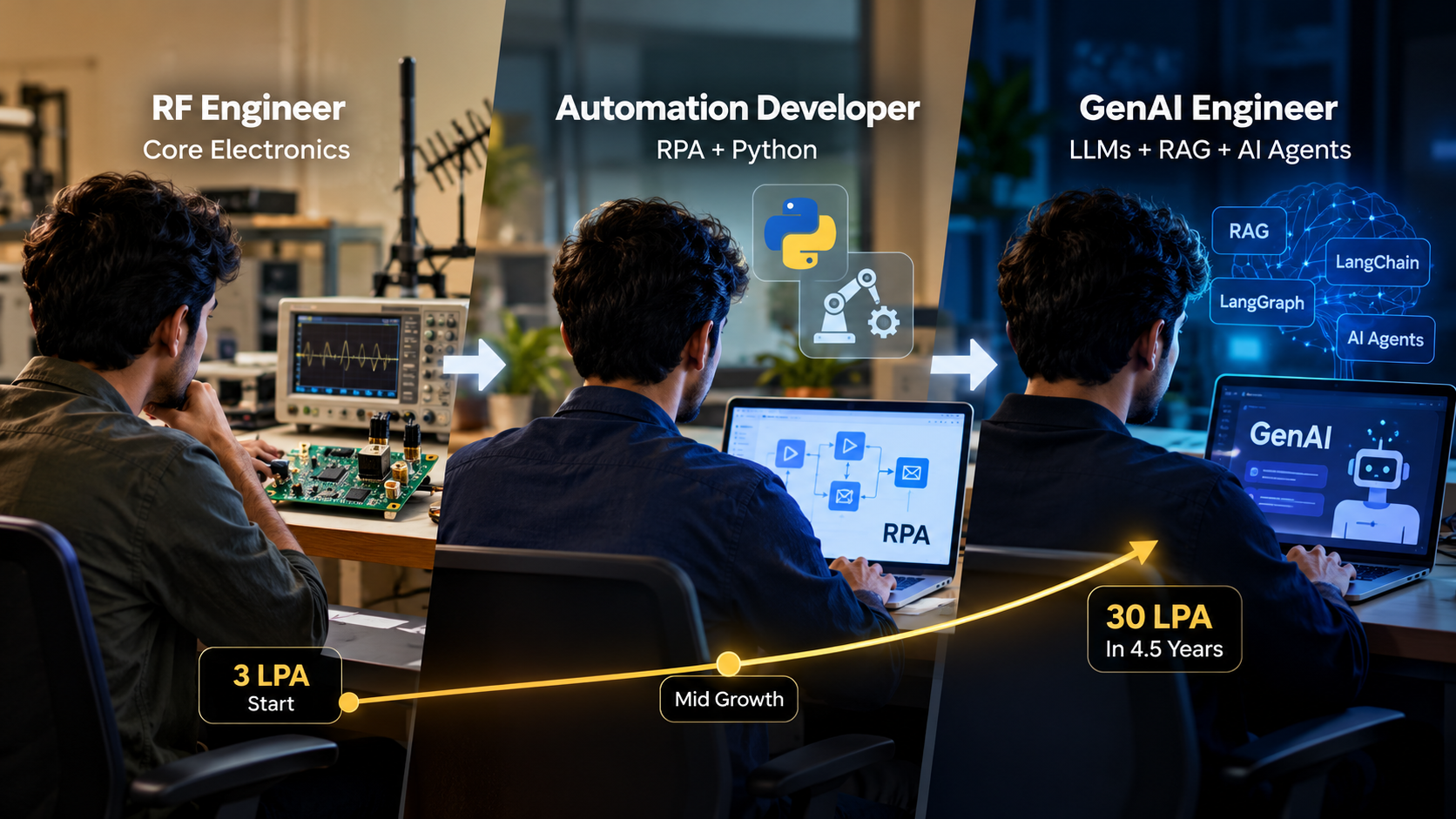
From RF Engineer to GenAI Engineer: My Career Switch from 3 LPA to 30 LPA in 4.5 Years
When I started my career, I never imagined that I would eventually work with Generative AI, large language models, RAG pipelines, and AI agents.
Like many engineering graduates, I began with a traditional engineering role. I entered the core electronics domain and started working as an RF Engineer. At that point, my focus was on learning the job, gaining experience, and building a professional career.
However, after around six months, I started questioning whether I wanted to continue in the same domain for the long term.
I began researching career opportunities, exploring different technical fields, and trying to understand where I could build a stronger future.
That decision became the starting point of a journey that took me from core electronics to IT automation, from RPA to Python-based development, and eventually toward Generative AI.
Over approximately 4.5 years, my compensation progressed from 3 LPA to 30 LPA.
This is not a story about finding a shortcut to a high-paying job. It is about recognising when to change direction, learning the skills required for the next opportunity, and continuing to adapt as technology evolves.
1. Starting My Career in Core Electronics
My professional journey began in the electronics domain as an RF Engineer.
Initially, I focused on understanding my responsibilities, learning from practical work, and gaining experience in my chosen field.
But after around six months, I started thinking beyond my current job.
I wanted to understand the career opportunities available in India, the skills required for different technical roles, and the potential for long-term professional growth.
I researched the technology industry and compared different career options. During this process, I became interested in IT because it offered opportunities to work with software, logical problem-solving, programming, and business applications.
I did not immediately know which IT role would suit me best. I had to explore the available options before making a decision.
One thing was clear: if I wanted to change my career, I needed a practical learning plan rather than simply leaving my existing field.
2. Choosing Between Testing Automation and Automation Development
While exploring IT careers, I came across two paths that interested me: testing automation and automation development.
Testing automation focuses on automating test cases and checking whether software behaves as expected.
Automation development focuses on building solutions that reduce repetitive manual work and improve business processes.
I was more interested in the development side because I enjoyed logical thinking and wanted to build solutions that addressed real business problems.
However, I faced one challenge: my programming knowledge was limited.
I understood that becoming a developer required more than knowing how to operate a tool. I needed to learn how automation worked, how workflows were designed, and how technical problems could be solved.
Instead of giving up on the idea, I continued researching.
That was when I discovered Robotic Process Automation, commonly known as RPA.
3. Discovering RPA: My Entry Point into IT
RPA introduced me to a practical way of building automation solutions.
RPA platforms provide visual workflows, drag-and-drop activities, and reusable components that help automate repetitive business processes.
For someone entering IT without strong programming experience, this offered a useful starting point.
I began learning RPA tools, understanding workflow design, and exploring how businesses could automate routine tasks.
After approximately six months from the beginning of my professional journey, I transitioned into the IT field.
During my early experience, I worked on client projects, learned how to understand business requirements, and helped build automation solutions.
I also had opportunities to explore Python-based automation.
That experience helped me understand an important distinction: automation is not limited to a single platform.
Some problems can be solved efficiently with RPA tools, while others require Python, APIs, custom logic, or a combination of technologies.
I gradually became more comfortable with the technical side of automation and started thinking beyond drag-and-drop workflows.
RPA became more than a tool I had learned. It became my entry point into software-based problem-solving.
4. Learning Python and Expanding Beyond Tool-Based Automation
As I gained experience, I became increasingly interested in understanding what was happening behind an automation workflow.
I wanted to know how to write code, interact with APIs, handle errors, process data, and build solutions that could be customised for different requirements.
Python became an important part of that learning process.
Working with Python-based automation helped me explore a more flexible approach to development. Instead of relying entirely on predefined activities, I could implement logic directly and understand how different components interacted.
This also helped me recognise the value of programming fundamentals.
Learning a tool can help you get started, but understanding programming makes it easier to adapt when requirements change or a tool cannot solve a problem efficiently.
Over time, I built experience across automation tools and Python-based approaches.
I was learning not only how to automate a process, but also how to evaluate different ways of solving it.
That foundation later became useful when I started exploring AI applications.
5. After 3.5 Years, I Started Thinking About the Next Career Move
After approximately three and a half years in automation, I began researching my next career direction.
Technology was evolving quickly, and Generative AI was attracting significant attention.
I did not want to assume that traditional automation had no future. Businesses still need reliable workflows, integrations, and process automation.
However, I recognised an opportunity to expand my skill set beyond conventional rule-based automation.
Traditional automation works well when processes follow predefined rules. But business problems can also involve unstructured documents, natural-language questions, information retrieval, and tasks that require context.
AI-based applications can help address some of these problems.
I started asking myself:
How can I combine my existing automation experience with the emerging capabilities of AI?
This question led me to research artificial intelligence, machine learning, large language models, and Generative AI engineering.
Instead of starting my career exploration from zero again, I looked for a path that connected my existing skills with new technologies.
6. Why I Chose Generative AI
As I researched AI careers, I explored learning resources, online courses, technical tutorials, and practical demonstrations.
Some people around me were following structured AI courses. I also explored self-learning resources, including YouTube and educational channels such as CampusX.
My objective was to understand the technology, identify the skills required, and determine which areas I should learn first.
Generative AI particularly interested me because it connected programming with intelligent applications and business automation.
I began exploring large language models, retrieval-augmented generation, and AI agents.
The more I learned, the more I could see how these technologies could extend the work I had already been doing.
My previous experience had taught me how to understand business processes and build automation solutions. GenAI offered opportunities to connect those processes with enterprise knowledge, natural-language interfaces, and more flexible workflows.
I decided to focus on building practical skills instead of limiting myself to understanding AI concepts at a theoretical level.
7. Learning RAG, LangChain, LangGraph, and AI Agents
Moving toward GenAI required me to expand my technical foundation.
I focused on several important areas.
Python Programming
I continued developing my Python skills because programming is essential for building and integrating AI applications.
Large Language Models
I explored how LLMs work in practical applications, what they can do, and where their limitations become important.
Retrieval-Augmented Generation (RAG)
RAG was one of the important concepts I explored.
It combines information retrieval with language-model generation. An application can retrieve relevant information from a knowledge source and use that context to generate a response.
This is particularly useful for applications that need to answer questions using specific documents or business information.
LangChain
I learned how LangChain could help connect language models, prompts, retrieval components, and other application tools.
LangGraph
I explored LangGraph for building structured, stateful workflows in which multiple steps, tools, and decisions can be coordinated.
AI Agents
I began learning how AI applications can use tools, follow multi-step workflows, and perform tasks based on a defined objective.
Machine Learning Fundamentals
I also explored relevant machine learning concepts to strengthen my understanding of the broader AI field.
Learning these technologies was not simply about adding names to my résumé. I wanted to understand how they worked together and how they could be applied to actual problems.
8. Building Projects: Moving from Tutorials to Practical Experience
One of the biggest lessons I learned was that watching tutorials and building a working application are two different things.
A tutorial can explain how to create a RAG pipeline or connect an LLM to a tool. But when you build a project yourself, you must also consider data quality, retrieval accuracy, errors, application behaviour, testing, and limitations.
I started applying what I was learning through practical projects.
These projects helped me understand how individual components fit together and what additional work is needed to make an application useful.
I also began thinking more carefully about the business problem behind each implementation.
Instead of asking only, "How do I use this framework?" I started asking:
What problem am I trying to solve?
Why is an AI-based approach suitable for this problem?
What data does the application need?
How will I evaluate the quality of the output?
What happens when the model gives an incorrect or incomplete response?
How can the solution be made reliable enough for practical use?
These questions helped me move beyond simply learning frameworks and toward thinking like an AI application developer.
9. From 3 LPA to 30 LPA: What My Journey Taught Me
Over approximately 4.5 years, my compensation progressed from 3 LPA to 30 LPA.
Looking back, I do not attribute that progression to a single technology or course.
It happened during a period in which I changed domains, gained practical experience, expanded my technical capabilities, and continued learning.
My journey involved several important stages:
| Career stage | What I learned |
|---|---|
| Core electronics and RF engineering | Professional fundamentals and technical problem-solving |
| Transition into IT | How to research roles and choose a new direction |
| RPA and business automation | Workflow design and business process automation |
| Python-based automation | Programming, logic, and more flexible implementations |
| Generative AI | LLMs, RAG, AI frameworks, and agentic workflows |
| Practical project development | Applying concepts to real technical problems |
Each stage contributed to the next.
My electronics background was where I started. RPA helped me enter IT. Python helped me explore development beyond visual tools. GenAI introduced me to another set of opportunities for combining programming and automation.
My compensation progression reflects my individual experience. It is not a guarantee of what someone else will earn or how quickly they will achieve a similar result.
The more transferable lesson is that career growth can involve multiple deliberate decisions rather than one perfect decision at the beginning.
10. What I Would Recommend to Someone Who Wants to Switch Careers
If you are currently working in electronics, mechanical engineering, electrical engineering, testing, support, or another technical field, you do not necessarily need to discard your existing experience.
Start by identifying what you already know and what you want to do next.
Step 1: Research the Market
Look at current job descriptions on recruitment platforms and company career pages.
Identify the roles that interest you and the skills employers repeatedly request.
Do not rely entirely on social media trends or claims about the highest-paying technologies.
Step 2: Identify Your Skills Gap
Compare your existing skills with the requirements of your target role.
Separate the skills you already have from those you need to improve and those you must learn from scratch.
This gives you a practical learning plan.
Step 3: Choose One Primary Direction
Avoid trying to learn AI, cloud, cybersecurity, DevOps, and data engineering all at once.
Choose one target role, understand its requirements, and develop the skills necessary to pursue it.
Step 4: Build Practical Projects
Create projects that demonstrate your ability to solve problems.
For AI engineering, you might build a document-question-answering application using RAG. For automation, you might create a Python-based workflow that interacts with an API and handles errors.
Document your work, explain your design decisions, and be honest about its limitations.
Step 5: Use Your Existing Experience
Your previous domain may give you an advantage in specialised roles.
For example, an electronics engineer might explore signal processing or edge AI. A mechanical engineer might investigate manufacturing analytics or computer vision.
You can also pursue a broader software or AI engineering role if that better matches your interests and skills.
Step 6: Prepare for the Transition
Update your résumé to highlight relevant projects, transferable skills, and technical accomplishments that you can demonstrate.
Practise explaining your career change and why your new skills match the target role.
Where possible, continue learning while working and validate your options before making a major employment decision.
11. Common Mistakes to Avoid During a Career Switch
Following Every New Trend
Technology changes quickly. Learning every new tool is not a realistic strategy.
Focus on foundational skills and technologies that appear consistently in the job descriptions relevant to your goals.
Collecting Courses Without Building Anything
Courses can help structure your learning, but projects demonstrate whether you can apply what you have learned.
Try to build something useful alongside every major stage of your learning.
Ignoring Programming Fundamentals
Frameworks make development easier, but they do not remove the need to understand programming, debugging, APIs, data structures, and application logic.
Assuming a Career Switch Guarantees a Salary Increase
A new technology can create opportunities, but salary outcomes depend on experience, technical depth, interview performance, location, employer requirements, and market conditions.
Choose a path because it fits your long-term goals, not solely because someone else reported a high salary.
Treating Your Previous Experience as Wasted Time
Your earlier experience may provide transferable knowledge.
Identify what you can carry forward instead of assuming that every career change requires starting from the beginning.
Conclusion: Your First Job Does Not Have to Define Your Future
My journey from core electronics to RF engineering, then into RPA and eventually Generative AI, taught me the value of researching opportunities and adapting to change.
I did not begin with a complete career roadmap. I started by questioning whether my first career direction was right for me, explored alternatives, learned new technologies, and gradually built experience in a different field.
The biggest lesson is not that everyone should switch to AI.
It is that you should keep evaluating your career, understand where your skills fit, and be willing to learn when your goals or the industry change.
AI may be the right next step for some engineers. For others, cloud computing, cybersecurity, data engineering, industrial automation, or a combination of their existing domain and emerging technology may be a better fit.
Research the market. Build a learning plan. Develop practical projects. Keep improving.
Your first job is where your career begins, not necessarily where it must end.