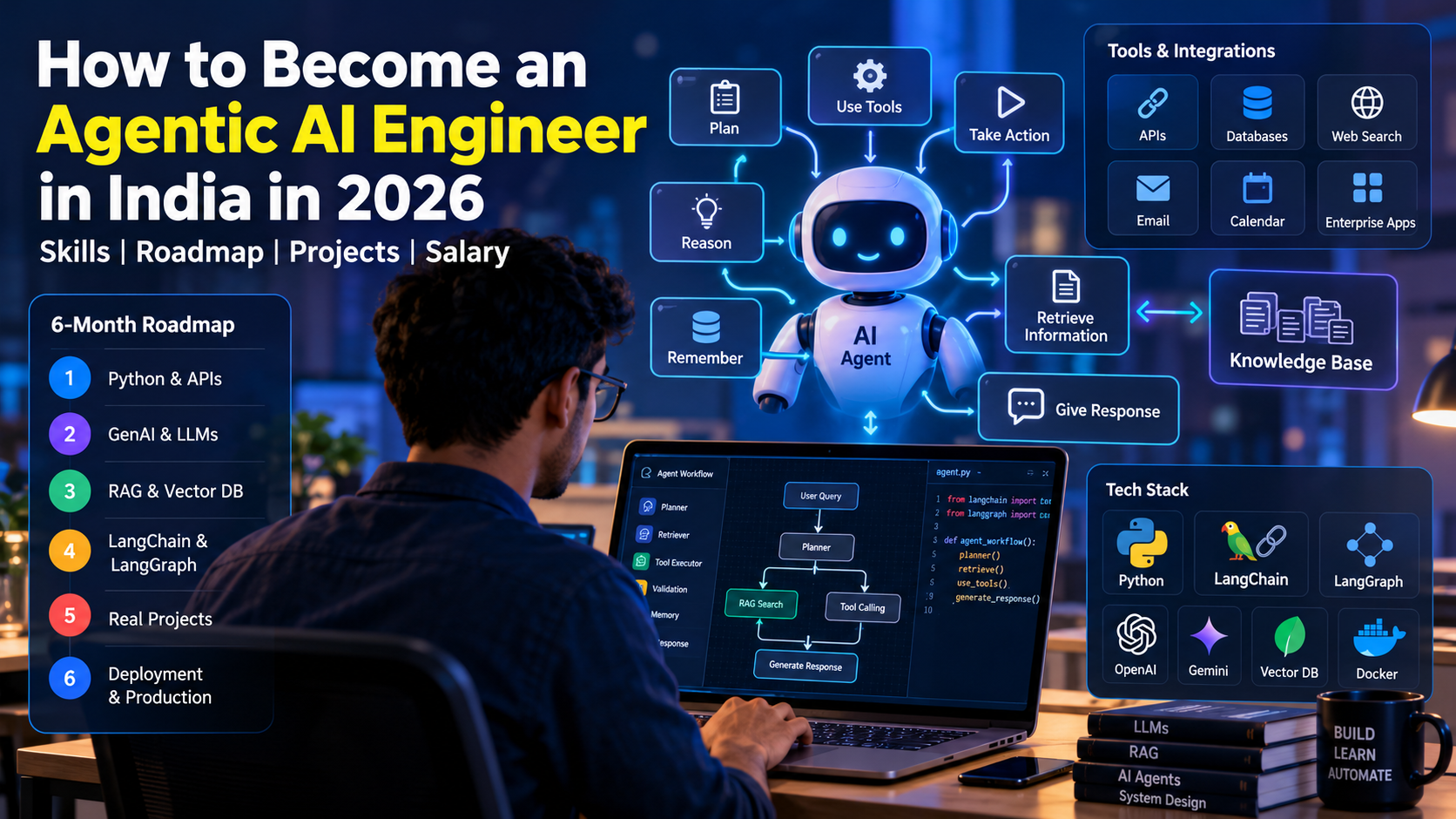
How to Become an Agentic AI Engineer in India in 2026: Skills, Roadmap, Projects & Salary
Artificial Intelligence is moving beyond chatbots and simple question-answering applications. Businesses are increasingly exploring AI systems that can understand goals, make decisions, use external tools, retrieve information and complete multi-step tasks with limited human intervention.
This evolution has created growing interest in a specialised career: Agentic AI Engineering.
If you are a student, software developer, Python programmer, automation engineer or IT professional planning to move into Artificial Intelligence, learning Agentic AI can help you build skills relevant to modern enterprise applications.
In this guide, you will learn what an Agentic AI Engineer does, which technical skills are required, how LangChain and LangGraph fit into the development process, which projects you should build, and how to prepare for AI engineering opportunities in India in 2026.
1. What Is an Agentic AI Engineer?
An Agentic AI Engineer designs and develops AI-powered systems that can perform tasks using reasoning, tools, memory and external integrations.
Unlike a traditional chatbot that mainly responds to a user's question, an AI agent can determine what actions are required to complete a task.
For example, consider a customer asking:
"Check my order status, identify why it is delayed and create a support ticket if necessary."
A traditional chatbot might explain how to check an order.
An AI agent could:
Understand the customer's request.
Identify the order number.
Call an order management API.
Retrieve the latest delivery status.
Analyse the reason for the delay.
Create a support ticket if the situation requires it.
Return a summary to the customer.
The agent uses an AI model to decide what to do next, while external tools perform specific operations.
The engineer's responsibility is to build this system, define its tools, control its behaviour, manage errors and ensure that it works reliably.
2. Why Is Agentic AI Becoming Important in 2026?
Companies are exploring AI systems that can do more than generate text. They want systems that can support business processes, automate repetitive operations and connect different enterprise applications.
According to a September 2026 press release by CIEL HR, demand for Agentic AI Engineer roles in India grew 260% in 2026 compared with 2025, based on its analysis of technology workforce demand.
This is a reported growth figure from one recruitment analysis, not a guarantee of job availability or future hiring.
Some important areas where Agentic AI is being explored include:
Customer support automation
IT service management
Enterprise workflow automation
Document processing
Software development assistance
Data analysis and reporting
Research and information retrieval
Business process automation
The Indian government's February 2026 report, AI as an Opportunity for India's Talent Pool, also discusses how AI is creating new employment opportunities and increasing the importance of advanced digital skills.
The opportunity is not limited to people who have completed a computer science degree. Developers and professionals with experience in automation, APIs, databases and business processes can also build a pathway into AI engineering.
3. Agentic AI Engineer vs GenAI Engineer vs ML Engineer
These roles are related, but their responsibilities are different.
| Role | Main responsibility | Example |
|---|---|---|
| Machine Learning Engineer | Builds and deploys predictive models | Predicting customer churn |
| GenAI Engineer | Develops applications using LLMs | Building a document question-answering chatbot |
| Agentic AI Engineer | Develops systems that plan and execute tasks using tools | An AI system that analyses a ticket and performs approved actions |
A GenAI application may generate a response based on a user's question. An Agentic AI application can go further by selecting tools, retrieving data and executing a controlled sequence of operations.
In real companies, these responsibilities can overlap. An engineer may work with machine learning, RAG, LLM applications and agent orchestration within the same project.
4. Technical Skills Required to Become an Agentic AI Engineer
You do not need to learn every AI framework at the beginning. Build your knowledge step by step.
4.1 Python Programming
Python is one of the most useful languages for AI application development.
Learn:
Variables, functions and classes
Object-oriented programming
Exception handling
File handling
List comprehensions and dictionaries
Asynchronous programming
API integration
Working with JSON
Virtual environments and package management
You should also understand how to develop REST APIs using FastAPI.
4.2 Generative AI and Large Language Models
Understand how Large Language Models work and how applications interact with them.
Important concepts include:
Large Language Models (LLMs)
Tokens and context windows
System and user prompts
Temperature and model parameters
Function calling and tool calling
Structured outputs
Embeddings
Model limitations and hallucinations
Explore models and APIs from providers such as OpenAI, Google Gemini and Anthropic.
You should understand that different models have different costs, capabilities, latency and context limits.
RAG allows an AI application to retrieve relevant information from external documents or databases before generating an answer.
A typical RAG architecture contains:
Document ingestion
Text extraction
Text chunking
Embedding generation
Vector database storage
Similarity search
Context retrieval
LLM response generation
Learn how to work with vector databases such as FAISS, Chroma or PostgreSQL with pgvector.
RAG is particularly useful for enterprise applications where answers must be grounded in internal documents and business information.
4.4 LangChain and LangGraph
LangChain and LangGraph are useful technologies for developing LLM applications and agentic workflows.
LangChain provides integrations and abstractions for models, tools, retrieval and agent development.
LangGraph provides orchestration capabilities for stateful, multi-step agent systems.
For example, a LangGraph workflow can contain:
A planning node
A retrieval node
A tool execution node
A validation node
A human approval node
A final response node
LangGraph supports persistence, durable execution and human-in-the-loop workflows.
You should understand both frameworks rather than assuming that one replaces the other.
4.5 APIs, Databases and Integrations
An AI agent becomes useful when it can interact with external systems.
Learn:
REST APIs
HTTP methods
Authentication and authorization
SQL
PostgreSQL
Redis fundamentals
Webhooks
JSON request and response structures
API error handling
For example, an IT support agent may need access to a ticketing API, employee database, knowledge base and notification service.
4.6 Agent Memory and Context Management
Memory allows an agent to retain relevant information across steps or interactions.
Understand these concepts:
Short-term conversation memory
Persistent workflow state
Long-term user preferences
Database-backed memory
Retrieval-based memory
Context management
Do not store every conversation permanently. Define what information should be retained, why it is needed and how users can control it.
4.7 Evaluation, Monitoring and Security
Building an agent is only one part of the job. Making it reliable is equally important.
Learn:
Prompt and response evaluation
Retrieval accuracy
Tool execution success rates
Latency and token cost monitoring
Logging and tracing
Retry and timeout handling
Human approval mechanisms
Role-based access control
Protection against prompt injection
Data privacy
Never allow an LLM to perform sensitive business operations without appropriate permission checks and validation.
5. Six-Month Roadmap to Become an Agentic AI Engineer
Here is a practical learning roadmap for someone who can dedicate approximately 1–2 hours daily.
Month 1: Python and API Development
Focus on Python fundamentals, OOP, REST APIs, JSON, FastAPI and SQL.
Build: A simple Python application that reads data from an API, processes it and returns a structured response.
Month 2: Generative AI and LLM Applications
Learn prompting, model APIs, embeddings, structured output and function calling.
Build: An AI chatbot that answers questions and uses a simple external tool.
Month 3: RAG and Vector Databases
Learn document processing, chunking, embeddings, retrieval and vector search.
Build: A PDF-based question-answering application that retrieves relevant document sections before answering.
Month 4: Agent Development with LangChain and LangGraph
Learn agent loops, tool calling, state management, workflow orchestration and conditional execution.
Build: An AI research assistant that can search approved sources, retrieve information and prepare a structured summary.
Month 5: Multi-Agent Systems and Enterprise Integration
Learn agent delegation, specialised agents, API integrations, memory and human approval.
Build: A customer support system with separate classification, knowledge retrieval and response-generation stages.
Month 6: Deployment and Production Readiness
Learn deployment, monitoring, security, evaluation and performance optimisation.
Build: Deploy one complete AI agent application with a frontend, backend, database, logs and controlled tool access.
At the end of six months, you should aim to have at least two or three well-documented projects rather than simply collecting course certificates.
The timeline is a suggested learning plan, not a guarantee of job readiness.
6. Five Practical Agentic AI Projects for Your Resume
Practical projects demonstrate whether you can apply AI concepts to real business problems.
Project 1: AI Customer Support Agent
Problem: Customer support teams receive repetitive questions every day.
Solution: Build an AI agent that understands customer requests, retrieves relevant knowledge and prepares responses.
Features:
Query classification
Knowledge-base retrieval
Order-status API integration
Response generation
Ticket creation
Human approval
Project 2: IT Service Management Agent
Problem: IT support teams spend considerable time analysing and categorising tickets.
Solution: Develop an agent that analyses incoming tickets, searches previous resolutions and recommends actions.
Features:
Ticket classification
RAG-based knowledge retrieval
Similarity matching
Resolution recommendations
Ticket escalation
Human approval before sensitive actions
You can combine your knowledge of RPA and AI to build this type of application.
Create a sample IT support knowledge base.
Extract and clean historical ticket information.
Generate embeddings using an embedding model.
Store the vectors in a vector database.
Implement semantic similarity search.
Connect the retrieved context to an LLM using LangChain.
Apply configurable similarity thresholds.
Test the system using different support queries.
Problem: Researching a technical topic manually takes time.
Solution: Develop an agent that searches approved sources, gathers information, compares findings and generates a report.
Features:
Search integration
Information extraction
Source references
Summarisation
Report generation
Project 4: SQL Data Analysis Agent
Problem: Business teams frequently need reports but may not know SQL.
Solution: Build an agent that converts natural-language questions into controlled SQL queries.
Features:
Natural-language query understanding
SQL generation
Query validation
Read-only database execution
Result analysis
Chart and report generation
Always use read-only permissions by default and restrict access to approved tables and operations.
Project 5: Personal AI Automation Assistant
Problem: People perform repetitive activities across multiple applications.
Solution: Build an assistant that can interpret instructions and perform approved operations through connected APIs.
Features:
Voice or text commands
Task planning
Calendar integration
Email drafting
Information retrieval
Task history
Confirmation before external actions
These projects can help demonstrate practical engineering skills during interviews.
7. Agentic AI Engineer Salary in India in 2026
Salary depends on experience, technical depth, company type, location and the ability to build production-ready AI applications.
There is no single verified salary range that applies to every Agentic AI Engineer in India.
As a useful reference, TeamLease Digital's 2026 AI talent analysis, reported in September 2026, lists GenAI Developer compensation at approximately:
₹11.2 LPA for 0–2 years of experience
₹34.5 LPA for 6–8 years of experience
These figures are for GenAI Developers, not a dedicated Agentic AI Engineer salary survey. They should be treated as market context rather than guaranteed salary expectations for agentic roles.
When evaluating a job opportunity, look beyond the job title. Check whether the role involves actual Python development, LLM integration, RAG, tool calling, orchestration, evaluation and deployment.
A developer who can build reliable enterprise AI systems may have a stronger profile than someone who only knows how to write prompts.
8. Free Resources to Learn Agentic AI
Here are some useful starting points:
Python
LangChain
LangGraph
RAG and LLM Applications
FastAPI
AI and Machine Learning
Start with official documentation and build small applications while learning. Avoid jumping between too many frameworks.
9. How to Prepare for Agentic AI Engineer Interviews
Once you have built practical projects, prepare for technical discussions.
Important interview topics include:
What is Agentic AI?
What is the difference between an AI agent and an LLM chatbot?
What is RAG and when should you use it?
What is the difference between LangChain and LangGraph?
How does tool calling work?
How do you manage agent memory?
How do you prevent infinite agent loops?
How do you evaluate an AI agent?
How do you handle API failures and timeouts?
How do you secure an agent that accesses enterprise systems?
When should you use a deterministic workflow instead of an autonomous agent?
How would you design a multi-agent system?